

Every dollar invested in user experience will return you $10 to $100 in the future. Yet many tech startups still treat UX as an afterthought, focusing solely on functionality or visual appeal. This misconception costs businesses millions in lost conversions and damaged credibility. User experience isn't just about making websites look good. It's a strategic investment that directly impacts your bottom line, user retention, and brand perception. This article breaks down how UX drives conversions, why edge cases matter more than you think, and how AI powered personalization can transform your website into a revenue generating asset.
Table of Contents
- Understanding The Critical Role Of User Experience In Website Design
- Financial And Business Impact Of UX Investment For Startups
- Addressing Edge Cases And Accessibility In UX Design
- Leveraging AI And Strategic Information Architecture To Enhance UX And Conversions
- Why Choose Yoad Mousai For Your UX Focused Web Design
- Frequently Asked Questions
Key takeaways
| Point | Details |
|---|---|
| UX delivers measurable ROI | Every dollar invested returns between $2 and $100, with conversion rate improvements up to 400%. |
| Poor UX drives users away | 94% of first impressions depend on design, and 75% of users judge credibility by aesthetics alone. |
| Edge cases prevent failure | Ignoring uncommon scenarios like name changes or account lockouts causes user frustration and churn. |
| AI enhances personalization | Collaborative filtering and behavioral forecasting increase conversion rates by up to 14.5%. |
| Strategic IA differentiates brands | Custom information architecture built on user intelligence outperforms generic templates for conversions. |
Understanding the critical role of user experience in website design
User experience encompasses every interaction someone has with your website. It includes usability, accessibility, desirability, and performance. When these elements work together seamlessly, users trust your brand and take action. When they don't, visitors leave within seconds.
Design aesthetics shape trust faster than any other factor. About 94% of first impressions of a digital product are based solely on its design. Your website has milliseconds to convince visitors you're credible. Poor visual hierarchy, confusing navigation, or slow load times destroy that trust instantly. Even worse, 75% of users judge credibility based only on aesthetics. If your site looks outdated or cluttered, potential customers assume your product is too.
Many startups fall into common UX traps. They assume users will figure out complex interfaces because the product is innovative. They prioritize feature quantity over interface clarity. They design for themselves rather than their actual audience. These mistakes cost conversions because real users don't behave like founders hope they will.
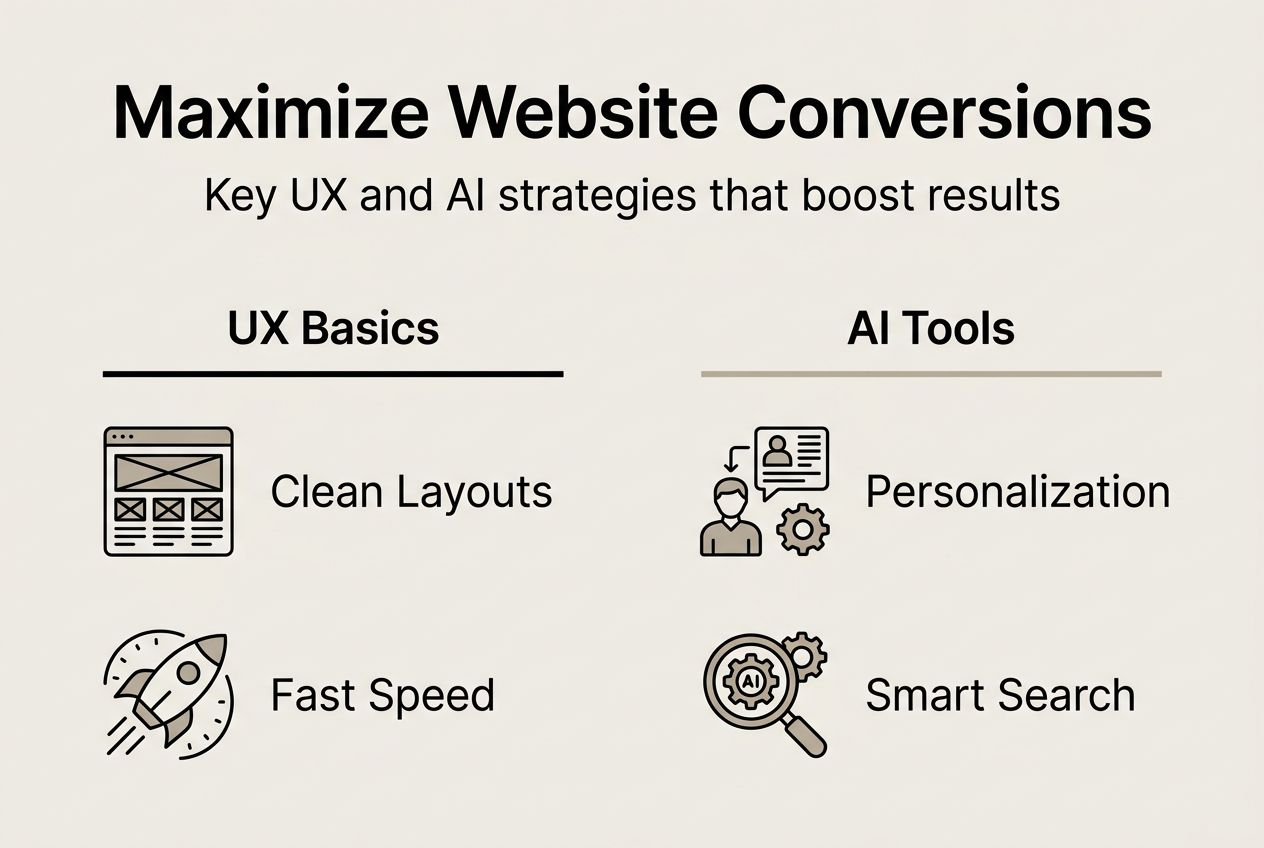
Effective UX design balances beauty with function. Clean layouts guide attention to conversion points. Fast loading speeds keep visitors engaged. Intuitive navigation helps users find what they need without thinking. Accessible design ensures everyone can use your product regardless of ability or device. When these pieces align, engagement skyrockets and conversions follow.
Pro Tip: Design for realistic user behavior, not idealized scenarios. Test your interface with actual users who match your target audience. Watch where they struggle, what they skip, and what confuses them. Real user feedback reveals problems you'll never spot in internal reviews.
Key UX elements that impact conversions:
- Visual hierarchy that directs attention to primary actions
- Loading speeds under three seconds across all devices
- Mobile responsive design that adapts to any screen size
- Clear value propositions visible above the fold
- Frictionless forms with minimal required fields
- Trust signals like testimonials and security badges
Financial and business impact of UX investment for startups
The financial case for UX investment is overwhelming. ROI on UX design ranges from $2 to $100 for every $1 invested. This isn't theoretical. Companies tracking UX improvements see measurable increases in revenue, retention, and customer lifetime value. For bootstrapped startups watching every dollar, UX delivers returns that dwarf most marketing channels.
Better UX directly increases conversion rates through reduced friction. A frictionless and well designed UX could increase conversion rates by as much as 400%. Simplifying checkout flows, clarifying calls to action, and removing unnecessary form fields can quadruple the percentage of visitors who become customers. These aren't minor tweaks. They're fundamental business improvements that compound over time.

Retention benefits are equally impressive. Companies that invest in improving customer experience often see substantial benefits such as a 42% increase in retention. Retained customers cost less to serve, buy more frequently, and refer others. For SaaS startups, improved retention through better UX can mean the difference between sustainable growth and constant churn.
Pro Tip: Measure UX impact with specific metrics tied to business outcomes. Track conversion rates by page, time to first action, task completion rates, and customer satisfaction scores. Present these numbers to stakeholders in terms of revenue impact, not abstract usability scores. When you show that a redesigned checkout flow added $50,000 in monthly revenue, budget conversations get easier.
| UX Metric | Business Impact | Research Source |
|---|---|---|
| Initial Investment ROI | $10 to $100 return per dollar | UX Planet |
| Conversion Rate Improvement | Up to 400% increase | Forrester |
| Customer Retention Boost | 42% increase | Keap Research |
| Credibility Assessment | 75% based on aesthetics | Toptal |
Smart startups treat UX as a growth lever, not a cost center. They allocate budget to user research, usability testing, and iterative design improvements. They hire designers who understand conversion psychology and developers who prioritize performance. They measure results and double down on what works. This approach transforms websites from digital brochures into revenue engines that scale with the business.
Addressing edge cases and accessibility in UX design
Edge cases are uncommon scenarios that most users won't encounter but some definitely will. They include situations like users needing to change their name, recovering locked accounts, or managing multiple profiles. Edge cases can lead to product failure if not addressed, causing user frustration and churn. When your product fails someone in a moment of need, they remember.
Common overlooked edge cases cause real problems. Name changes, account lockouts, and multiple account scenarios are common edge cases often overlooked. Someone gets married and can't update their name. A user forgets their password and discovers no recovery option. A customer wants to manage both personal and business accounts but your system only allows one. These aren't rare situations. They affect millions of users who then abandon your product for competitors that handle them gracefully.
Ignoring edge cases leads to exclusion and product failure for users with low vision, slow internet, or older devices. Accessibility isn't just about compliance. It's about reaching the broadest possible audience and ensuring your product works for everyone. Users with disabilities represent significant purchasing power, and accessible design often improves usability for everyone.
"Designing for edge cases isn't designing for the minority. It's ensuring your product doesn't fail when users need it most. Every edge case you ignore is a customer you're choosing to lose."
Handling edge cases requires proactive thinking and flexible systems. Build interfaces that accommodate variation rather than forcing users into rigid patterns. Provide multiple recovery options when things go wrong. Test with diverse users who represent different abilities, contexts, and use cases. The goal isn't perfection but graceful handling of unexpected situations.
Best practices for edge case design:
- Provide clear error messages with specific recovery steps
- Allow users to edit core information like names and emails
- Offer multiple authentication and recovery methods
- Design forms that accept international address formats
- Test with assistive technologies like screen readers
- Build progressive enhancement for slow connections
- Support keyboard navigation throughout the interface
- Include undo options for destructive actions
Inclusive design benefits everyone. Captions help users in noisy environments, not just deaf users. Keyboard navigation helps power users, not just those with motor impairments. Simple language helps non native speakers, not just those with cognitive disabilities. When you design for edge cases, you create more robust products that work better for all users.
Leveraging AI and strategic information architecture to enhance UX and conversions
AI transforms UX from static to adaptive, personalizing experiences based on individual behavior and preferences. Techniques like collaborative filtering, K means clustering, and gradient boosting machines analyze user patterns to predict what each visitor needs. Collaborative filtering significantly increased conversion rates up to 14.5% and loyalty index to 0.63. These aren't marginal improvements. They represent fundamental shifts in how users experience your product.
Collaborative filtering recommends content based on similar user behavior. If users who bought product A also bought product B, the system suggests product B to new customers viewing product A. K means clustering groups users by behavior patterns, allowing you to tailor interfaces for different segments. Gradient boosting machines predict which users are likely to convert and optimize their experience accordingly. Together, these techniques create dynamic interfaces that adapt to each visitor.
| AI Method | Primary Benefit | Conversion Impact |
|---|---|---|
| Collaborative Filtering | Personalized recommendations | Up to 14.5% increase |
| K Means Clustering | Behavioral segmentation | Improved targeting |
| Gradient Boosting | Conversion prediction | Optimized user flows |
| Behavioral Forecasting | Anticipate user needs | Reduced friction |
Strategic information architecture matters just as much as AI. Strategic IA built with customer intelligence, competitive analysis, and AI assisted pattern recognition leads to higher conversions. Generic templates can't match custom IA designed around your specific audience and business model. Your navigation structure, content hierarchy, and user flows should reflect how your customers actually think and search, not how template designers assumed users behave.
Effective IA starts with user research. Map customer journeys to understand how people discover, evaluate, and purchase your product. Analyze search queries to see what language they use. Study competitor sites to identify gaps and opportunities. Use card sorting exercises to understand how users mentally categorize your content. Then build navigation and hierarchy that matches these mental models.
Pro Tip: Integrate AI insights with strategic IA to create self optimizing experiences. Use behavioral data to identify which user segments convert best through which paths. Then adjust your IA to make those paths more prominent for relevant users. This combination of human strategy and machine learning creates interfaces that improve automatically over time.
IA best practices for conversion optimization:
- Design navigation around user goals, not internal departments
- Limit top level menu items to seven or fewer options
- Use clear, specific labels instead of clever or vague terms
- Create multiple paths to high value content
- Implement breadcrumbs for complex site structures
- Use search analytics to inform navigation decisions
- Test IA with actual users before full implementation
The combination of AI personalization and strategic IA creates competitive advantages that compound. As your system learns from user behavior, it gets better at predicting needs and optimizing experiences. As your IA aligns more closely with user mental models, visitors find what they need faster. Together, these improvements drive higher engagement, stronger loyalty, and better conversions.
Why choose Yoad Mousai for your UX focused web design
You've seen how critical user experience is for conversions and business growth. Implementing these strategies requires expertise in both design and development. That's where specialized UX focused web design makes the difference between a site that looks good and one that drives results.
I build custom websites and digital platforms for tech startups and innovative brands that want to stand out online. My work combines clean development, modern design, and conversion focused user experience. Every project starts with understanding your users and business goals, then building strategic IA and adaptive interfaces that turn visitors into customers. Many clients partner with me long term, building digital assets that generate ongoing revenue rather than just launching a one time website. If you're ready to maximize conversions through strategic UX design, let's talk about your project.
Frequently asked questions
What constitutes user experience in website design?
User experience encompasses usability, accessibility, desirability, and performance across every interaction with your website. It includes visual design, navigation structure, loading speeds, content clarity, and how easily users accomplish their goals. Good UX feels invisible because everything works exactly as users expect.
How does UX impact startup website conversions?
UX directly affects conversion rates by reducing friction and building trust. Well designed experiences can increase conversions by up to 400% through simplified flows, clear calls to action, and fast performance. Poor UX causes immediate abandonment, with 94% of first impressions based solely on design quality.
Why are edge cases important in UX design?
Edge cases represent uncommon but real scenarios that can cause product failure if ignored. Situations like name changes, account recovery, and accessibility needs affect millions of users. Addressing edge cases prevents frustration and churn while making your product more robust for everyone.
How can AI improve user experience on websites?
AI personalizes experiences by analyzing behavior patterns and predicting user needs. Techniques like collaborative filtering increase conversion rates up to 14.5% by recommending relevant content. Behavioral forecasting reduces friction by anticipating what users want before they ask.
What is strategic information architecture and why does it matter?
Strategic IA is the deliberate organization of content and navigation based on user research and business goals. It outperforms generic templates by matching how your specific audience thinks and searches. Custom IA built with customer intelligence and competitive analysis leads to higher conversions and better user satisfaction.