

Despite website personalization's proven impact on engagement and sales, only 25% of marketers have the data necessary to execute it effectively. Even fewer have the right technology in place. This disconnect creates a massive opportunity for tech startups willing to master personalization strategies. In this guide, you'll discover what website personalization actually entails, how it works under the hood, and practical steps to implement it successfully in your business.
Table of Contents
- What Is Website Personalization And Why It Matters
- How Website Personalization Works: Mechanics And Technology
- Case Study: How Marc Jacobs Drives Sales With Personalization
- Implementing Website Personalization: Best Practices For Tech Startups
- Take Your Website Personalization To The Next Level
Key takeaways
| Point | Details |
|---|---|
| Personalization drives measurable results | Website personalization significantly increases engagement and conversion rates when executed with proper data and technology. |
| Data and technology gaps persist | Only 25% of marketers have adequate data, and just 19% have the right technology to support personalization strategies. |
| Real-time systems deliver optimal performance | Modern personalization pipelines process millions of items and return results in under 50 milliseconds using AI-powered recommendations. |
| Marc Jacobs proves the ROI | The brand generates 9% of online revenue through AI personalization, reaching 22% during peak shopping periods. |
| Testing enables continuous improvement | Built-in A/B testing frameworks let you validate strategies and evolve personalization based on actual performance data. |
What is website personalization and why it matters
Website personalization tailors content, product recommendations, and offers based on individual user data and behavior. Instead of showing identical content to every visitor, personalized sites adapt dynamically to match each person's interests, location, purchase history, and browsing patterns.
The benefits are substantial. Personalization increases user engagement by serving relevant content that resonates with individual needs. It boosts conversion rates by presenting the right offers at the right moments. User satisfaction improves when experiences feel intuitive and helpful rather than generic.
For tech startups and modern marketers, personalization has become a competitive necessity. Customers expect experiences that acknowledge their preferences and history with your brand. Generic websites feel outdated and frustrating by comparison.
The challenge lies in execution. Only 25% of marketers have adequate data to support personalization efforts. Technology gaps, integration complexity, and resource constraints create additional barriers.
Successful personalization typically combines two approaches:
- Data-driven personalization uses demographic information, purchase history, and explicit preferences to segment audiences and tailor experiences
- Behavioral personalization tracks real-time actions like page views, clicks, and cart additions to predict intent and serve relevant content dynamically
- Contextual personalization considers device type, location, time of day, and referral source to optimize the experience for each situation
The most effective strategies blend all three methods, creating sophisticated systems that respond to users as unique individuals rather than demographic categories.
How website personalization works: mechanics and technology
Modern personalization relies on sophisticated technical infrastructure that captures, processes, and acts on user data in real time. Understanding these mechanics helps you evaluate tools and build effective strategies.

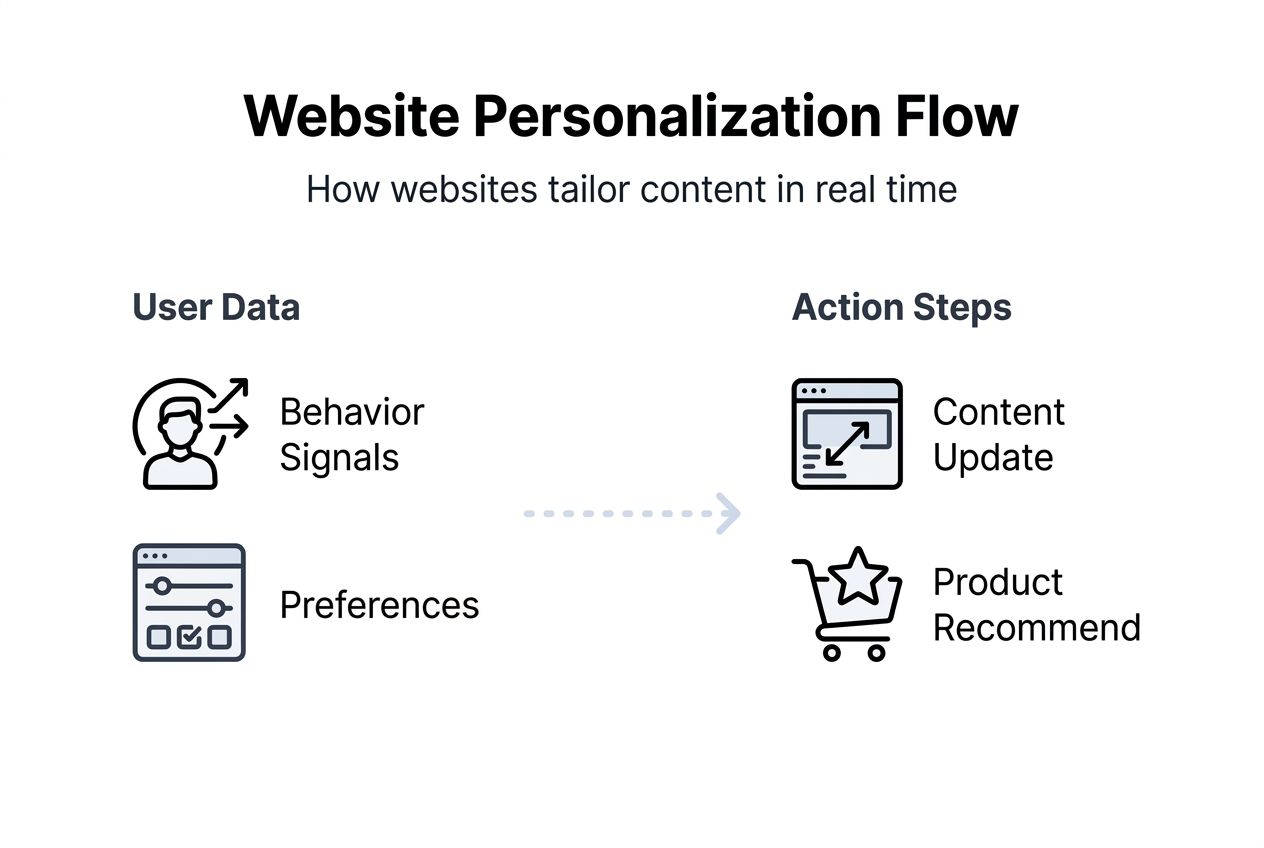
The process begins with data ingestion. Your system captures behavioral signals like page views, clicks, searches, and purchases. It also collects contextual information including device type, location, referral source, and session history. User profiling combines this real-time data with historical patterns to build comprehensive pictures of individual preferences and intent.
AI and machine learning power the recommendation engines at the heart of personalization. These systems analyze millions of data points to predict what content, products, or offers will resonate with each visitor. Real-time personalization pipelines process this analysis and return results in under 50 milliseconds, ensuring seamless user experiences without lag.
The technical architecture typically includes multiple stages:
- Candidate generation identifies potentially relevant items from your full catalog based on user profile and context
- Filtering applies business rules to remove out-of-stock items, enforce merchandising priorities, or exclude inappropriate content
- Ranking scores remaining candidates using machine learning models trained on conversion data and engagement patterns
- Experimentation runs A/B tests to validate personalization strategies and optimize performance continuously
- Delivery renders personalized content on your site with sub-second latency
The critical insight: effective personalization captures user intent in the moment, not from yesterday's batch job. Stale data leads to irrelevant recommendations and missed opportunities.
Pro Tip: Investing in scalable real-time infrastructure ensures seamless user experiences and delivers better conversion lift than slower batch-based systems. Your technology stack should process events as they happen, not hours later.
Integration across your marketing stack amplifies personalization impact. Connect your personalization engine with email platforms, advertising tools, and customer data platforms to create consistent experiences across every touchpoint.
Case study: how Marc Jacobs drives sales with personalization
Marc Jacobs exemplifies effective website personalization in action. The luxury fashion brand implemented AI-powered recommendations across multiple site locations to boost engagement and drive sales.
Their strategy targets high-impact areas:
- Homepage personalization greets returning visitors with curated product selections based on browsing history and purchase patterns
- Category page optimization arranges products dynamically to surface items most likely to interest each shopper
- Personal storefronts create individualized 'For You' pages that function as customized shopping destinations
- Cart and checkout enhancements suggest complementary items that increase average order values
The results demonstrate personalization's revenue impact. Marc Jacobs generates 9% of total online sales through AI-powered personalization during normal periods. This percentage climbs dramatically during peak shopping seasons, reaching up to 20% of sales during holidays.
During Black Friday Cyber Monday, personalization drove 22% of site sales by leveraging tailored recommendation logic to create urgency and surface relevant products at the perfect moments.
| Metric | Performance |
|---|---|
| Normal period sales from personalization | 9% of online revenue |
| Holiday season impact | Up to 20% of sales |
| Black Friday Cyber Monday peak | 22% of site sales |
| Technology partner | Nosto AI platform |
Marc Jacobs also integrates merchandising rules with AI recommendations. During clearance events, their system automatically targets specific customer segments with markdown offers on relevant items. This combination of automated intelligence and strategic business rules maximizes both conversion rates and profit margins.
Pro Tip: Closely monitor performance metrics and run controlled experiments to evolve your personalization strategy based on actual customer behavior rather than assumptions. Marc Jacobs uses Nosto's built-in A/B testing framework to validate every major change before full rollout.
The brand's success stems from treating personalization as an ongoing optimization program rather than a one-time implementation. Continuous testing and refinement keep strategies aligned with changing customer preferences and seasonal patterns.
Implementing website personalization: best practices for tech startups
Successfully implementing personalization requires honest assessment of your current capabilities and strategic planning. Start by evaluating your data, technology, and team resources.
Audit your data foundation first. Do you capture behavioral signals like page views, clicks, and searches? Can you track individual users across sessions? Do you have historical purchase data and customer profiles? Only 19% of marketers have adequate technology to execute personalization strategies, so identifying gaps early prevents wasted effort.
Prioritize real-time personalization tools over batch processing systems. Capturing user intent in the moment delivers significantly better results than acting on yesterday's data. Look for platforms that process events as they happen and update recommendations dynamically.
| Approach | Advantages | Disadvantages |
|---|---|---|
| AI-powered recommendations | Scales automatically, discovers patterns humans miss, adapts continuously | Requires significant data, less transparent logic, setup complexity |
| Manual segmentation | Full control over rules, easy to understand, quick to implement | Labor-intensive, doesn't scale, misses subtle patterns |
| Hybrid model | Combines AI intelligence with business rules, balances automation and control | More complex architecture, requires both technical and strategic expertise |
Focus personalization efforts on high-impact locations where small improvements generate substantial revenue:
- Homepage makes critical first impressions with returning visitors who have established preferences
- Product and category pages influence browsing behavior and discovery of relevant items
- Shopping cart presents opportunities for complementary product recommendations and upsells
- Post-purchase touchpoints build loyalty through personalized thank you pages and email follow-ups
Implementation roadmap for startups:
- Data audit to identify what customer information you capture and where gaps exist
- Tool selection evaluating platforms based on your technical capabilities, budget, and scaling needs
- Pilot test starting with one high-impact location to prove value before expanding
- Measurement establishing clear metrics and tracking systems to quantify personalization impact
- Iteration using A/B testing and performance data to refine strategies continuously
Don't overlook data privacy and consent management. Build transparent systems that explain how you use customer data. Provide easy opt-out mechanisms. Comply with regulations like GDPR and CCPA from day one rather than retrofitting compliance later.
Start small but think big. A focused pilot on your homepage with clear success metrics builds organizational confidence and budget for expansion. Trying to personalize everything at once typically leads to mediocre execution across all touchpoints.
Take your website personalization to the next level
Website personalization transforms generic browsing experiences into engaging, conversion-focused journeys tailored to each visitor. But implementing sophisticated personalization requires technical expertise and strategic design.

Professional web design services help you integrate real-time personalization engines, AI-powered recommendation systems, and continuous testing frameworks seamlessly. Expert developers ensure your personalization infrastructure scales reliably while maintaining fast page loads and excellent user experiences.
Custom strategies designed specifically for tech startups maximize engagement and conversions by focusing personalization efforts on your highest-impact opportunities. From initial data architecture to ongoing optimization, professional support accelerates your personalization journey and delivers measurable ROI.
FAQ
What data types are commonly used for website personalization?
Behavioral data including page views, clicks, and search queries provides real-time intent signals. Demographic information, purchase history, device type, and location data enable targeting. Combining multiple data points creates more accurate personalization than relying on single sources.
How does real-time personalization improve user experience?
Real-time personalization processes user actions instantly to deliver current, relevant content based on what someone is doing right now. This approach matches their actual intent instead of relying on outdated batch data from previous sessions. The result feels more intuitive and helpful.
What are common challenges in implementing website personalization?
Insufficient customer data and inadequate technology platforms create the primary barriers to effective personalization. Many organizations also lack skilled resources to build and maintain sophisticated systems. Integration complexity between marketing tools adds another layer of difficulty.
How can startups test and measure personalization effectiveness?
A/B testing variations of personalized content against control groups measures actual impact on engagement and conversion rates. Built-in testing frameworks let you validate strategies before full rollout and continuously optimize based on performance data. Track metrics like click-through rates, time on site, and revenue per visitor.