

Many startups assume website templates are enough in the early stages. However, custom websites outperform templates with 20-40% higher conversion rates and dramatically better user engagement metrics. This article explains why investing in website design drives measurable business growth, improves brand presence, and creates competitive advantages that templates simply cannot match. You'll learn when to make the switch, how to measure ROI, and what distinguishes strategic design investment from quick-fix solutions.
Table of Contents
- Key takeaways
- What does investing in website design mean for startups?
- Custom website design versus templates: a performance and cost comparison
- How superior user experience drives conversions and startup growth
- When to invest in custom website design: balancing costs, scale, and startup needs
- Upgrade your startup's website with expert custom design
- FAQ
Key Takeaways
| Point | Details |
|---|---|
| Custom sites outperform templates | Custom websites deliver 20 to 40 percent higher conversion rates and dramatically stronger user engagement than template based sites. |
| Strong ROI from UX | Investing in UX design yields a high return on investment and can drive exponential business growth. |
| Performance boosts growth | Improvements in site performance raise customer retention and revenue through faster load times and better user experiences. |
| Scaling with tailored design | A customized design approach is essential for startups moving beyond the early MVP stage to support rapid growth. |
| Long term value vs cost | Even with higher upfront costs and longer timelines, custom design pays off through sustained gains over time. |
What does investing in website design mean for startups?
Investing in website design goes far beyond choosing colors and fonts. For startups, this investment means building a custom digital platform tailored specifically to your brand identity, target users, and business objectives. Unlike template-based approaches that offer generic solutions, strategic design investment involves deep user research, conversion optimization, and technical architecture that supports your growth trajectory.
This approach incorporates proven UX frameworks like Google's HEART methodology to measure happiness, engagement, adoption, retention, and task success. UX design yields $100 return per $1 invested precisely because it prioritizes research, testing, and accessibility to enhance every user interaction. You're not just building a website but creating a revenue-generating asset that evolves with your business.
Technical performance and accessibility are integral components of smart design investment. Modern users expect lightning-fast load times, seamless mobile experiences, and interfaces that work for everyone regardless of ability. These elements directly impact your bottom line through improved search rankings, lower bounce rates, and higher conversion rates.
Key components of strategic website design investment include:
- Custom brand identity and visual design that differentiates you from competitors
- User research and persona development to understand your target audience deeply
- Conversion-focused UX architecture with clear user journeys and calls-to-action
- Performance optimization for Core Web Vitals and mobile-first experiences
- Accessibility compliance ensuring your site works for all users
- Scalable technical foundation supporting future features and integrations
- Ongoing testing and iteration based on real user behavior data
This comprehensive approach differs fundamentally from template and launch quick fixes. While templates offer speed and low initial cost, they lack the strategic foundation that drives sustainable growth. Custom design investment positions your startup for long-term success by creating digital experiences that truly resonate with your audience and support your unique value proposition.
Custom website design versus templates: a performance and cost comparison
The performance gap between custom websites and templates is substantial and measurable. Custom websites outperform templates with 20-40% higher conversion rates, translating directly to more leads, sales, and revenue. Custom sites typically achieve conversion rates of 2.8-4.5%, while template-based sites hover around 1.8-2.4%. This difference compounds over time, creating exponential value as your traffic grows.
Core Web Vitals metrics tell an equally compelling story. Custom websites consistently score better on Largest Contentful Paint (LCP), First Input Delay (FID), and Cumulative Layout Shift (CLS). These technical performance indicators matter because Google uses them for search rankings, and users abandon slow or unstable sites within seconds. Custom design allows optimization at the code level, eliminating bloat and unnecessary features that drag down template performance.

| Metric | Custom Design | Template Design |
|---|---|---|
| Conversion Rate | 2.8-4.5% | 1.8-2.4% |
| Initial Cost | £5,000-50,000+ | £200-2,000 |
| Timeline | 6-12 weeks | 1-2 weeks |
| LCP (Load Speed) | <2.5s typical | 3-5s typical |
| Customization | Unlimited | Limited to theme |
| Scalability | Built for growth | Often requires rebuild |
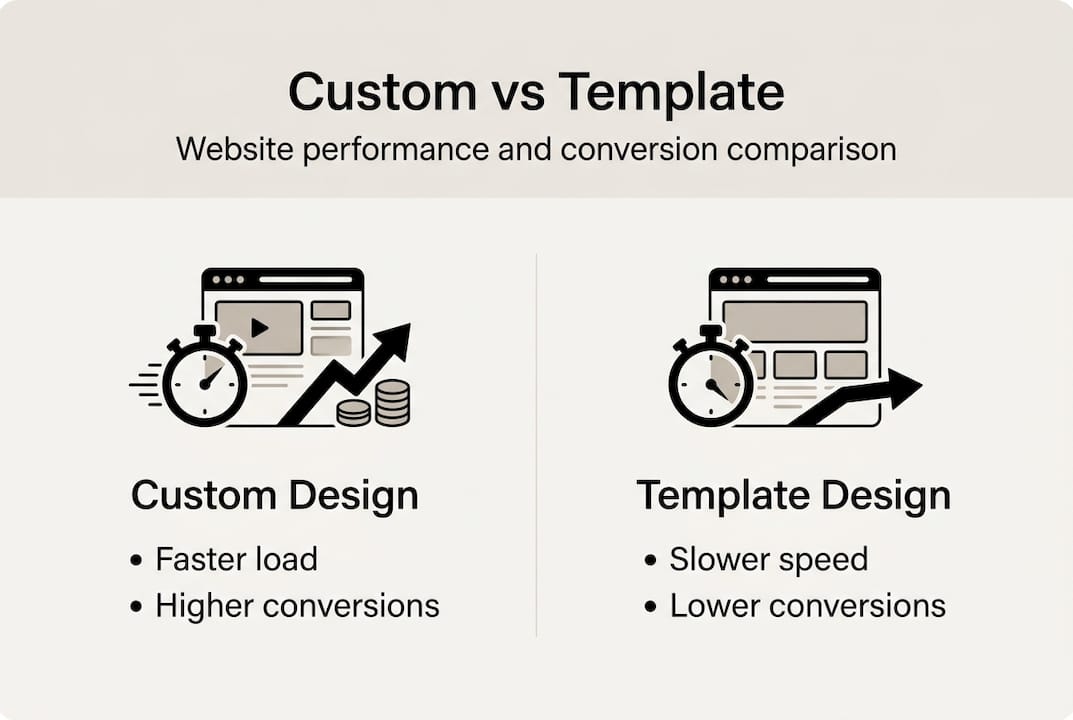
Cost and timeline differences are significant but must be evaluated against long-term value. Templates are dramatically cheaper, ranging from £200 to £2,000, and can launch in one to two weeks. Custom costs 5-10x more with longer timelines but better scale support, typically requiring six to twelve weeks and budgets of £5,000 to £50,000 or more depending on complexity. However, payback periods at scale often run just 12-18 months when conversion improvements are factored in.
Startups with revenue below £50,000 annually often perform perfectly well with quality templates. At this stage, speed to market and capital preservation matter more than optimization. Templates allow you to test product-market fit, gather user feedback, and validate your business model without significant upfront investment.
Key considerations when choosing between custom and template:
- Current revenue and growth trajectory
- Unique feature requirements and third-party integrations
- Brand differentiation needs in your competitive landscape
- Technical performance requirements for your user base
- Timeline constraints and go-to-market urgency
- Available budget and expected ROI timeline
Pro Tip: Evaluate switching from template to custom when you notice conversion rate plateaus, performance issues affecting user experience, or when your template can't support new features critical to your growth strategy. Track metrics for three months to identify clear inflection points.
How superior user experience drives conversions and startup growth
User experience is the invisible force multiplying every marketing dollar you spend. When visitors land on your site, they make snap judgments within 50 milliseconds about credibility, professionalism, and whether you can solve their problem. Superior UX design ensures those critical first impressions convert into engaged users who complete desired actions.
UX design yields $100 return per $1 invested, delivering up to 400% higher conversions compared to poorly designed experiences. This extraordinary ROI stems from removing friction at every step of the user journey. When navigation is intuitive, content is scannable, and calls-to-action are clear, users naturally progress toward conversion without conscious effort.
Page performance metrics directly correlate with revenue outcomes. Core Web Vitals impact on conversion rates shows that improving Largest Contentful Paint from 4 seconds to 2 seconds can boost conversions by 40-50%. Layout stability matters equally because unexpected shifts frustrate users and erode trust. Every 0.1 second improvement in load time can increase conversion rates by 8-10% for e-commerce sites.
| UX Metric | Business Impact | Measurement |
|---|---|---|
| Page Load Speed | 40-50% conversion increase | LCP <2.5s |
| Mobile Usability | 60% of traffic retained | Mobile-first design |
| Navigation Clarity | 35% task completion boost | User testing success rate |
| Accessibility | 15-20% audience expansion | WCAG 2.1 compliance |
| Visual Hierarchy | 25% engagement increase | Heatmap analysis |
Implementing outcome-driven UX strategies requires systematic approaches:
- Conduct user research through interviews, surveys, and behavior analytics to understand pain points and motivations deeply
- Create detailed user personas representing your core audience segments with specific goals and frustrations
- Design mobile-first experiences since over 60% of web traffic now comes from mobile devices
- Implement A/B testing for critical conversion paths, testing one variable at a time for clear attribution
- Ensure accessibility compliance to reach the broadest possible audience and improve overall usability
- Optimize Core Web Vitals through code efficiency, image optimization, and server response improvements
- Apply clear visual hierarchy guiding users naturally toward high-value actions
Pro Tip: Measure UX success through business metrics, not just design metrics. Track conversion rate, average order value, customer lifetime value, and user engagement alongside traditional UX metrics like task completion rate. This connects design decisions directly to revenue outcomes and builds stakeholder buy-in.
"Companies that invested in design outperformed the S&P 500 by 219% over 10 years. Rakuten24 saw 150% revenue increase after redesigning their user experience to prioritize mobile shopping and streamlined checkout flows."
The compound effect of superior UX becomes apparent over time. Small improvements across multiple touchpoints create dramatic cumulative impact. A 10% improvement in conversion rate combined with 15% better retention and 20% higher average order value doesn't add up linearly but multiplies to transform business economics entirely.
When to invest in custom website design: balancing costs, scale, and startup needs
Timing your investment in custom website design requires honest assessment of your startup's current stage and future trajectory. Design decisions depend on startup scale and integration needs, with templates serving early-stage startups well but becoming limitations as complexity grows. The transition point varies by business model, but clear indicators signal when custom design becomes essential.
Startups with revenue below £50,000 annually typically benefit more from templates than custom solutions. At this stage, you're validating product-market fit, iterating rapidly based on feedback, and conserving capital for core product development. Templates provide professional presence without significant investment, allowing you to focus resources on customer acquisition and product refinement.
Beyond £2 million in annual revenue, custom design becomes not just beneficial but necessary for sustainable growth. Your website handles significant traffic, supports complex user journeys, and represents substantial brand equity. Template limitations around performance, customization, and scalability create tangible revenue constraints that custom design removes.
Evaluating ROI on design investment requires focusing on proxy metrics rather than direct attribution. ROI hard to attribute directly with design because multiple variables influence business outcomes simultaneously. Instead, track conversion rate improvements, average order value increases, customer retention changes, and user engagement metrics before and after design updates. These proxies provide clear evidence of design impact on business performance.
Clear indicators signaling it's time to invest in custom design:
- Monthly traffic exceeds 50,000 visitors and performance issues affect user experience
- Conversion rate plateaus despite ongoing marketing investment and optimization efforts
- Your template can't support critical features or integrations required for your business model
- Competitors with custom sites are winning customers based on superior digital experiences
- Brand differentiation becomes essential in your market and templates limit visual identity
- You're planning significant scale and need modular architecture supporting future growth
- Customer feedback consistently mentions website limitations or usability problems
- You're raising capital and need professional digital presence reflecting your valuation
Long-term scale considerations should influence your decision timeline. Custom websites built with modular architecture support feature additions without complete rebuilds. You can add e-commerce, customer portals, API integrations, and advanced functionality as your business evolves. Templates often require complete replacement when requirements exceed their capabilities, creating disruption and additional cost.
Unique integration needs also drive custom design requirements. If your business depends on proprietary systems, specialized databases, or complex third-party services, templates rarely offer the flexibility required. Custom development allows seamless integration with your tech stack, creating unified experiences that templates can't match.
Upgrade your startup's website with expert custom design
Your website should be a revenue-generating asset, not just a digital brochure. I specialize in building custom web design services tailored specifically for tech startups that need to stand out in competitive markets. My approach combines clean development, modern design principles, and conversion-focused user experience to create websites that drive measurable business growth.
Every project starts with understanding your unique value proposition, target audience, and growth objectives. I partner with clients long-term, building digital platforms that generate ongoing revenue rather than delivering one-time websites. Whether you're ready to scale beyond templates or need a complete digital transformation, let's discuss how strategic design investment can accelerate your startup's growth trajectory and enhance your brand visibility.
FAQ
What is the typical return on investment for custom website design?
Custom website design offers exceptionally high ROI, with UX design yielding $100 return per $1 invested according to industry studies. This translates to approximately 9,900% ROI when implemented effectively. However, direct attribution is challenging because multiple business variables influence outcomes simultaneously. Focus on proxy metrics like conversion rate improvements, average order value increases, and customer lifetime value changes to measure design impact accurately.
When should a startup switch from website templates to custom design?
Switch from templates to custom design when your revenue, traffic, or technical requirements exceed template capabilities. Startups with revenue below £50,000 can use templates effectively, but beyond £2 million annually, custom design becomes essential for sustainable growth. Other triggers include conversion rate plateaus, performance issues affecting user experience, unique feature requirements, or when brand differentiation becomes critical in your competitive landscape.
How can startups measure the success of their website design investment?
Track conversion rates, average order value, customer retention metrics, and user engagement indicators to measure design success. Apply frameworks like HEART for holistic UX evaluation, measuring happiness, engagement, adoption, retention, and task success. Monitor Core Web Vitals for technical performance, conduct A/B testing on critical conversion paths, and gather qualitative feedback through user interviews. Compare metrics before and after design changes to isolate impact clearly.
Does custom website design improve search engine rankings?
Custom design significantly improves search rankings through better Core Web Vitals performance, mobile optimization, and technical SEO implementation. Google prioritizes fast-loading, mobile-friendly sites with excellent user experience in search results. Custom sites typically achieve superior LCP, FID, and CLS scores compared to templates, directly influencing rankings. Additionally, custom design allows strategic content architecture, schema markup, and technical optimizations that templates often restrict.
What ongoing costs should startups expect with custom websites?
Ongoing costs for custom websites include hosting (£50-500 monthly depending on traffic), security updates, content management, and periodic feature enhancements. Budget 15-20% of initial development cost annually for maintenance and improvements. However, custom sites often have lower long-term costs than templates because they're built specifically for your needs without unnecessary features. Plan for quarterly performance reviews and annual strategic updates to maintain competitive advantage and optimal user experience.